When you walk into a workplace with spotless floors, gleaming fixtures, and fresh air, your initial reaction is usually visual. But behind that pleasant, organized first impression is something far more vital to your business: microbiology.
To the untrained eye, cleaning is simply about removing visible dirt, clutter, and dust. But to professional janitorial teams, clean is a precise science. The real threat to your workplace environment isn’t just the dust you can see—it is the invisible bacteria, viruses, and pathogens multiplying on high-touch surfaces.
Here is a look behind the curtain at the science of commercial sanitation, and how professional janitors actively safeguard your staff, clients, and bottom line from illness.
1. Cleaning vs. Sanitizing vs. Disinfecting: Knowing the Difference
One of the biggest misconceptions in facility maintenance is that “cleaning” and “disinfecting” are the same thing. In reality, chemical sanitation relies on a strict hierarchy:
-
Cleaning: The physical removal of germ-laden dirt, organic matter, and debris using soap, water, and friction. Cleaning doesn’t necessarily kill germs, but it lowers their numbers and removes the organic shield that protects them.
-
Sanitizing: Reducing bacterial counts on surfaces to levels deemed safe by public health standards.
-
Disinfecting: Using EPA-registered chemicals specifically formulated to kill 99.999% of microscopic pathogens—including influenza, norovirus, and staph bacteria—on hard surfaces.
Professional janitors don’t just pick up a spray bottle and start wiping. They execute a multi-step protocol: first removing surface soils so that professional disinfectants can directly contact and eradicate targeted pathogens.
2. The Chemistry of “Dwell Time”
Have you ever seen someone spray a counter and immediately wipe it off a second later? In the world of commercial hygiene, that mistake is known as bypassing dwell time.
Every medical-grade disinfectant requires a specific amount of time to remain visibly wet on a surface to destroy the cell walls or viral envelopes of harmful germs.
-
Depending on the product and target pathogen, effective dwell times range anywhere from 30 seconds to 10 full minutes.
-
If a chemical is wiped away prematurely, pathogens survive, adapt, and continue to spread.
Trained janitorial crews understand product chemistry. They calculate dwell times properly, ensuring disinfectants complete their microscopic job before any surface is wiped down.
3. Stopping Cross-Contamination with Color-Coded Microfiber
Using the same rag to wipe down a restroom counter and then a office desk is a recipe for cross-contamination. Professional cleaning services prevent cross-contamination through strict material management protocols:
Color-Coded Fiber Systems
Commercial teams utilize strict color-coded microfiber systems to isolate cleaning tools by zone:
-
Red/Pink: High-risk restroom areas (toilets, urinals)
-
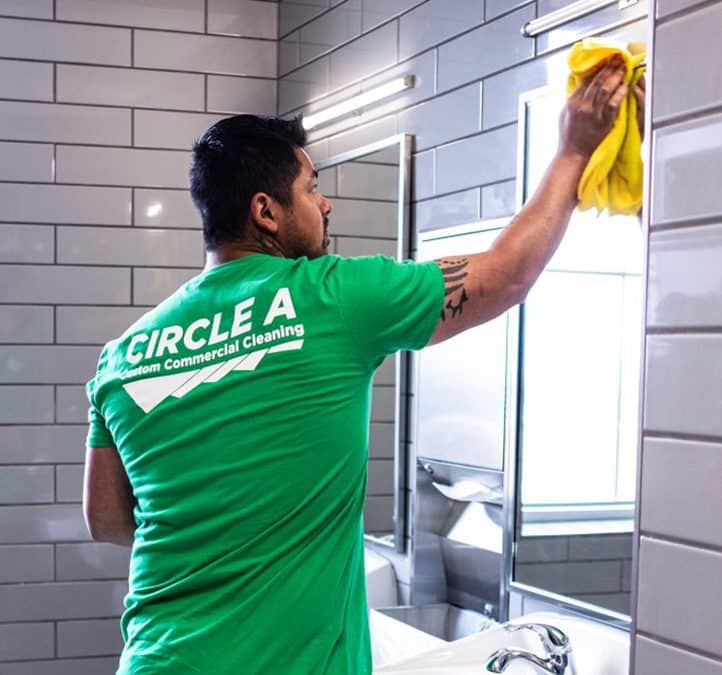
Yellow: Lower-risk restroom surfaces (sinks, mirrors)
-
Blue: General office areas, desk spaces, and common rooms
-
Green: Food preparation and breakroom areas
The Power of Microfiber
Unlike traditional cotton rags or paper towels that simply push grime around, synthetic microfiber features millions of tiny split fibers. Microfiber carries a positive charge that attracts negatively charged dust, dirt, and microbes, pulling them off the surface and trapping them deep within the cloth structure.
4. Prioritizing High-Touch Vector Points
Germs don’t spread evenly across a building; they migrate along specific human traffic routes. A science-backed cleaning program focuses heavy disinfection efforts on high-touch vector points:
-
Doorknobs, push plates, and exit handles
-
Light switches and thermostat controls
-
Elevator buttons and stair railings
-
Shared office equipment (copier touchscreens, keyboards, desk phones)
-
Breakroom microwave handles, refrigerator doors, and coffee maker buttons
By systematically targeting these hot spots on a daily schedule, professional janitors break the chain of infection before a single sick employee can pass a virus to an entire department.
5. The Business Impact: Healthier Teams, Stronger Productivity
Investing in professional janitorial care isn’t just an operational expense—it’s an investment in risk management and workforce performance:
-
Reduced Absenteeism: According to health studies, structured workplace hygiene programs can reduce sick leave and unplanned absenteeism by up to 30% to 80%.
-
Improved Indoor Air Quality (IAQ): Commercial HEPA-filtration vacuums trap 99.97% of airborne particles as small as 0.3 microns, pulling pollen, dust mites, and airborne allergens out of carpets and soft seating.
-
Employee Peace of Mind: A visibly pristine, thoroughly sanitized workplace boosts morale, reassuring team members and visiting clients that their health and safety are taken seriously.
Protect Your Facility with Circle A Janitorial Services
For over 40 years, Circle A Janitorial Services has served as a trusted commercial cleaning partner for businesses, industrial sites, worship facilities, and construction operations throughout Lubbock and West Texas.
Founded in 1984 on a commitment to quality, dependability, and custom service, our bonded and insured team combines decades of industry experience with tailored janitorial plans designed around your building’s unique layout and schedule.